 SEESE
8-in-1 wire stripper with voltage tester
$15.99★ 4.298 rated it
A nicked conductor breaks later, inside a wall, where finding it costs an afternoon. The habits that keep the copper whole.
Why a nick mattersThe notch does the measuringCheck before fingers commitOne handle from pocket to crimp
A stripped wire that lost a sliver of copper still works on the day you connect it. The trouble arrives later. The nick is a thin spot that heats up under load and a hinge that fatigues every time the wire flexes, and when it finally lets go it does so inside a junction box or a wall.
So the whole game of stripping is taking the insulation off while leaving the strands exactly as the factory drew them. Slower is part of it. The right notch is most of it.
Stripping stations on our pliers are sized holes, each matched to a gauge. In the right notch the edges part the insulation all the way around and stop short of the metal; a pull slides the jacket off whole. In a notch one size small, the edges land in the copper itself.
When the gauge is unclear, start a size large and step down until the jacket pulls clean. Cutting into the metal to find out is the expensive way to learn the same thing.
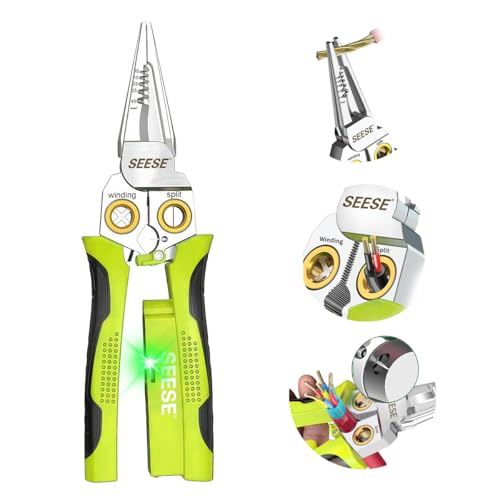
The habit that outranks every other habit here: know what is live before touching strands. Our needle nose pair carries a tester in the body that answers with light and sound, so checking a suspect wire happens before the jaws do anything at all.
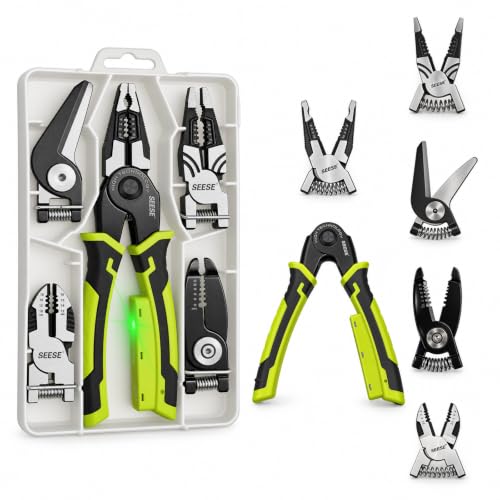
The swap head set carries its own tester for the same reason, and it answers from a doorbell transformer up to a wall circuit without touching bare metal. Same principle either way. Ask the wire first.
The long nose pair strips, cuts and crimps in one body, which sounds like a listing sentence until the day it is not. Halfway up a ladder, the difference between one tool and three is the difference between finishing and climbing down.
The swap head set trades that for range: five heads on one grip, so the diagonal cutter becomes snips and then long nose without a walk back to the bench. One lives in a back pocket, the other in its case in the bag.
The figure is what the listing showed when we last checked it. The listing itself keeps the current one.